Sunday, August 21, 2011

Late to the Party--15-60-75: The Numbers Band's "Jimmy Bell's Still in Town" (1976)

While the music scenes based around Los Angeles and New York City get most of the press, Northern Ohio produced a healthy number substantial musical acts in the 1970s. Devo, Chrissie Hynde of The Pretenders, Pere Ubu, and The Dead Boys all originated there, and so did lesser-known but no less brilliant groups like Rocket from the Tombs, The Electric Eels, Ex-Blank-Ex, Tin Huey, and The Waitresses. One of the hidden gems of the Kent, Ohio scene has remained 15-60-75, also known more simply as The Numbers Band. They formed in 1970 and are still active to this very day, primarily playing in small clubs in Ohio. The band has counted among its alumni Gerald Casale (later a founding member of Devo), David Robinson (who drummed in the original line-up of The Modern Lovers and in The Cars), Terry Hynde (Chrissie Hynde's brother), and Chris Butler (the leader of Tin Huey and the primary songwriter of The Waitresses, who had a MTV hit in the early 1980s with "I Know What Boys Like"). To most experts, their crowning achievement is their 1976 live album Jimmy Bell's Still in Town. It was recorded June 16th, 1975 at the Agora in Cleveland. Reportedly, The Numbers Band was the opening act for Bob Marley and the Wailers. When it was released in album form a year later, it appeared on their Water Records label, getting little distribution, and quickly falling into obscurity. Long since championed by David Thomas of Pere Ubu (who currently releases the album on his Hearpan Records label), it has maintained a small but loyal group of listeners.

Jimmy Bell's Still in Town is a remarkably tight set, and each of its five tracks flow smoothly into each other, as if there are no breaks between the songs. It is also rather difficult to categorize. Ostensibly, The Numbers Band are a roadhouse blues rock band. The title of the album even refers to an obscure blues 1958 song by Cat Iron called "Jimmy Bell." Their ten minute cover of the song, on Side Two, is without question the centerpiece of the album. While the stamp of the blues is all over this record, it is a remarkably off-kilter variation on the form. It hints at Captain Beefheart and His Magic Band's 1968 Mirror Man sessions, but is far more cohesive. Similarly, the lineup and musical arrangement of The Numbers Band is highly unusual by blues band standards. They have two guitarists (frontman Robert Kidney and Michael Stacy), a bassist (Drake Gleason), and a drummer (the aforementioned David Robinson), which is not all that aberrant. However, their sound is augmented by three saxophonists (Robert Kidney's brother Jack, Terry Hynde, and Tim Maglione). Their ensemble playing is disquieting and discordant, their horns often slipping slightly out of pitch. When they solo, they owe more to Ohio native Albert Ayler than to, say, Jr. Walker or King Curtis. The guitar solos vary range traditional blues workouts to oblique motifs that foreshadow the playing of Tom Verlaine or a more restrained Robert Quine. As a result, Jimmy Bell's Still in Town is an album in which comparisons to the first two Bruce Springsteen LPs and later recordings such as Pere Ubu's The Modern Dance, Television's The Blow-Up, and Morphine's Cure for Pain are all appropriate. It is not an album that necessarily resonates on first spin, though. This is because the material is so uniformly constructed and tightly delivered that it's often difficult to distinguish when they are improvising or deviating from the structure of the tunes. Vocalist Robert Kidney's vocals are largely free from emotion or theatricality, which can give off the initial impression that he is not all that enthusiastic about the material. But once you recognize the powerful and unusual grooves they are able to develop and pursue, it becomes a thoroughly rewarding experience.

Jimmy Bell's Still in Town is available from Hearpan Records' website.

Below is an audio clip of "Jimmy Bell."

Wednesday, July 27, 2011

Book Review: 33 1/3 #71 It Takes a Nation of Millions to Hold us Back


I had mixed feelings going into Christopher R. Weingarten's volume on Public Enemy's classic album, It Takes a Nation of Million to Hold us Back. On the one hand, I wanted to be blown away by the book because it is about one of my favorite hip hop albums ever. On the other, I was kind of dreading reading an entire book written by Weingarten, known around Twitter as a bit of a reactionary curmudgeon. While I am certainly entertained by Weingarten's antics on Twitter and the constant arguments he provokes through his, ahem, strong opinions (latest: complaining about the state of interviewing), I wasn't sure I wanted to read an entire book by the man. If you haven't read his tweets, you might have encountered the video of Weingarten's stunning rant about the state of music criticism in the age of the internet, given at a conference a few years back. Or maybe you've heard about his successful attempt to review 1,000 records via Twitter (which was later released as this odd artifact). But alright--so that's Chris R. Weingarten, and this review is about a book he wrote, not the man himself. Still, while I was excited to read about It Takes a Nation of Millions to Hold us Back, I was also worried that Weingarten might fuck it up with his weird, angsty, reactionary music critic persona.

Well, Weingarten didn't fuck it up. In fact, It Takes a Nation of Millions... turned out to be one of the best entries in the 33 1/3 series. It gets off to a bit of a slow start as the author provides context that doesn't quite fit (yet, it makes sense soon), but once the book gets rolling, Weingarten's explorations of the various samples that make up Public Enemy's classic record are engaging--revelatory even. Perhaps the single most important factor in making Weingarten's book a success is his ability to combine narrative and analysis in conveying the history of the album's key samples. He doesn't simply identify a sample's source and move on, he recreates the historical moment of each sample and, in the process, shows us that It Takes a Nation of Millions... is a daring and political record through and through, not just because of Chuck D's lyrics and Public Enemy's persona, but also because many of the key samples were pulled from historically loaded cultural moments. In the process, we learn a little bit about James Brown, his bands, and his contributions to African American culture. We also learn about Funkadelic, Stax records, the Wattstax festival, early hip hop--the list goes on and on. What I find most surprising about Weingarten's discussion of this source material is, while I've always been aware of many of the sample's sources (though I was unaware of just as many), I've never considered their import so thoroughly until reading this book.

Eventually, Weingarten's volume runs out of steam a bit. The final chapter turns toward a discussion of how It Takes a Nation of Millions... has, itself been sampled and how it continues to remain a vital cultural artifact. Unfortunately, this last chapter feels more like an epilogue than chapter eight, or like the 80's movie that gives a brief summary of what happened to each character after the movie. After being immersed in Weingarten's fascinating historical narratives and analysis, I found the last chapter's rapid-fire rundown a bit unnecessary. Granted, the record's influence isn't really the book's focus, but why not put some time into telling more of the stories behind PE's influence on culture instead of just mentioning some times they were sampled.

Of course, that's just a quibble, and the lesser ending doesn't really detract much from the book as a whole. In writing this review, it occurs to me that Weingarten's volume can be a very useful book. In my comp/rhet studies, I've read a glut of material about "remix" culture, or the "rip, mix, burn" mindset. But in their discussions of sampling and digital culture, few of these scholars ever really address the potential for the intertextual methods they are describing. If I had a bit more money, I'd probably carry a dozen copies of Weingarten's book with me at all times so that, when someone uses sampling in the context of comp/rhet, I could give them a copy and tell them how much more exciting their ideas are than they even know.

So there--while I don't always agree with his reactionary woke-up-on-the-wrong-side-of-the-bed tweets, I have to admit that Christopher R. Weingarten has written one of the finest books in the 33 1/3 series.

Thursday, July 14, 2011

Songs that Changed the Landscape of Human Thought and Understanding: Men Without Hats' "The Safety Dance"

Societies demand safety. That's a fact. Why do you think prisons exist? Long before Michel Foucault examined the prison as a metaphor and tool for authoritarian control of the populace in his highly influential study Surveiller et Punir (Discipline and Punish) in 1975, America's first goth kid, Nathaniel Hawthorne, was making similar observations. In his cheery piece of fiction, The Scarlet Letter (1850), his narrator makes the following statement: "The founders of a new colony, whatever Utopia of human virtue and happiness they might originally project, have invariably recognized it among their earliest practical necessities to allot a portion of the virgin soil as a cemetery, and another portion as the site of a prison." While this is unmistakably true, because Hawthorne was NEVER wrong, one thing Utopias have long overlooked, for some unknown reason, is dancing kids. According to our society's elders, these spastic little jerks have been wreaking havoc on the world since they first decided to swivel their hips and gyrate in sexually-suggestive ways. History is filled with examples of dancing kids messing things up. William Shakespeare's tragedy Romeo and Juliet is fully based on the notion of these fools and their disruptive, lascivious ways. Years later, Jerome Robbins and Robert Wise brought this tale to the big screen in the form of West Side Story (1961), which filled with racist, finger-snapping kids with social diseases. In 1978's blockbuster Saturday Night Fever, dancing kids who are into disco get into more gang fights, have unprotected sex, rape a woman, do more racist stuff, commit suicide, and wear horrible shoes. Fortunately, the geniuses in Men Without Hats provided an alternative, a social salve, if you will, when they unleashed "The Safety Dance" on the great unwashed dancing masses in 1982. Because it championed safety in the art of the dance, it instantly became the greatest song of the 1980s, even better than Joe "Bean" Esposito's "You're the Best."

With its throbbing, minimal bassline and infectious hook, Men Without Hats, led by the great Ivan Doroschuk, found a simple way for kids to dance without unleashing their homicidal, herpes-infected ribaldry upon the poor proles who just want to go to their jobs in peace, drink the weekend away, and continually ruin their credit scores. Doroschuk's solution: an enclave for dancing kids away from the rest of society. He sings, "We can go where we want to / A place where they'll never find / And we can act like we come from out of this world / Leave the real one far behind." Furthermore, if you don't dance, then "you're no friend of mine." Soon, the powers that be took notice of Men Without Hats' brilliant scheme. By establishing dancing "zones," or what the Reagan administration would soon name "dance clubs," these "imbecile(s)" who are always "out of control," according to Doroschuk, could fraternize with each other, frolic, and basically do their thang all over each other. The most brilliant thing about Men Without Hats' "The Safety Dance" is that comes across as pure anarchy in dance, giving it an edge for all those would-be nonconformist dancing kids. Really, though, the dance is all about safety, as the title suggests, because the main move in the dance involves "look(ing) at your hands." Clean hands help reduce sickness and The Safety Dance, with its insistence upon hand-looking, reduced instances of the common cold by one million percent, according to the Wikipedia entry on hyperbole. Because of "The Safety Dance," the tyrannical terrorism of dancing kids has been blotted out completely ... Well, unless you count Footloose, or the terrorist attacks of September 11th, 2001.

Tuesday, July 12, 2011

Book Review: 33 1/3 #78 Pretty Hate Machine

I don't know if this accurate and, if it is, what the circumstances behind it might be, but I feel like we've been waiting on Daphne Carr's 33 1/3 volume on Pretty Hate Machine forever. It wasn't a title I was particularly excited about as I haven't listened to much NIN since I stopped being seventeen, but I was curious to see what a writer as accomplished as Carr might do with the album. Turns out, this book was well worth the wait. Instead of setting out to "read" or "explain" Reznor's seminal album, Carr's project centers on locating Pretty Hate Machine in time, space, and memory. In pursuing this project, Carr provides important bits of Reznor's (and his family's) history, brief narratives of important cities in NIN's history, namely Mercer, PA, and Youngstown and Cleveland, Ohio, fan oral histories, and explorations of the sub(and mall)cultures to which Reznor's music was instrumental. That may sound like a lot of disparate material to cover in a 150 page (plus notes) book, but Carr's overarching focus on culture and her discretion in limiting each section to essential components keeps the book moving and developing in a number of interesting ways.

In a move that seems both bold and necessarily obvious, Carr begins her volume on Pretty Hate Machine with a discussion of the trench coat mafia, the tragedy at columbine, and the resulting media frenzy surrounding NIN and like artists. Why begin there, of all places? Because it was the point at which the culture that grew out of NIN's music was in the media spotlight, the moment when all of the kids in corners were suddenly dragged into the light in a flurry of paranoia and fear. In other words, it makes perfect sense to begin a book about culture with the moment when that culture was the most seen.

But Carr's book goes so much further than simply exploring that gothic/industrial culture. In her own words, by telling the story of NIN and Pretty Hate Machine, Carr was able "to tell the story of lower-middle-class white men in the Rust Belt through a narrative beginning with Trent's birth and leading to the album's birth, as a mirror of American transition from Industrial to Information Age labor" (10). This is where Carr's take on Pretty Hate Machine excels, and what sets it apart from other books in the 33 1/3 series. The story Carr is exploring is so much bigger than just an album--she's taking on class, race, economics, urban decay, privilege, etc...So thorough is Carr's exploration of NIN's impact on culture, and culture's reliance on NIN, that the books final chapter includes a brief history of Hot Topic and its intertwining with Reznor and his music.

Of course, what stands out most about Carr's book is her willingness to let her subjects speak for themselves. In the process, they say some insightful things, some intelligent things, some horrifying things, some tragic things, and some disturbingly unintelligent things, but Carr never really judges them. She let's them tell their stories and, through the context she provides, let's her readers come to their own conclusions (with only one or two fleeting exceptions). This, more than anything, is what makes Carr's book such a compelling read--it's not just about the culture of NIN fans, it is in part by them. Any author who trusts her subjects and her audience that much deserves some serious respect. So thanks, Daphne Carr, for adding a new highlight to the 33 1/3 series. My only regret is that I didn't read this book sooner so I could assign it for the class I'm teaching this fall.

Thursday, June 2, 2011

Songs that Changed the Landscape of Human Thought and Understanding: Spandau Ballet's "True"

It was 1983. People drove to work in horseless carriages. They used telephones with wires attached to them. They wondered how Ronald Reagan's hair got so darned black. It was also the year that we learned the truth about truth. Spandau Ballet's tasty piece of "sophisto-pop," "True," is easily one of the most mind-blowingly brilliant singles ever committed to any recorded media. Gary Kemp, the song's writer, penned the perfect melody for the group's baritone singer, Tony Hadley, who articulately communicates, to his audience, the essence of truth. In the process, he makes a mockery of Western philosophy with brilliant ease.

Philosophers had been contemplating truth for years, from the Platonic ideal to the Nietzschean will to power. A breakthrough occurred in the 1930s, when philosopher Alfred Tarski gave the following example: "Snow is white if and only if snow is white." You can't argue with that logic. Well, Spandau Ballet decided to revise this precise if nonsensically coined formula by way of a fruitful combination of British New Wave and Yacht Rock. Tony Hadley seemingly non-verbal singing during the chorus actually packs plenty of meaning. "Ah ah ah ahhhh ah," he sings, in sexy croon-breaths. What most listeners fail to realize upon first listen is that this utterance is the crystallization of all truths. He explains, "Why do I find it hard to write the next line? / Oh I want the truth to be said," continuing, "Ah ah ah ahhhh ah / I know this much is true." What could quite plausibly be understood as an admission of writer's block is really a profound, mind-blowing truth in and of itself: "Ah ah ah ahhhh ah" is truth and truth is "Ah ah ah ahhhh ah." Suck on that, Alfred Tarski.

The key to understanding the perspective of Spandau Ballet is hidden within its chorus as well. Hadley sings, "I bought a ticket to the wor-or-orld, but now I've come back again." Clearly, Spandau Ballet was collectively abducted by a super-intelligent race of skinny tie-wearing aliens who taught them their culture and all of their knowledge. The only thing they couldn't teach Spandau Ballet was how to alleviate homesickness and how to give up the desire to feel sexy. So, after some time spent in space, probably in the months between their 1982 album Diamond and the one this appears on (clearly also titled True), they purchased tickets to return to Earth. Fueled by this new knowledge, as well as months of pent-up sexual frustration, they were inspired to tell us "this much is true" as well as include one of the decade's hottest slow-burn sax solos during the bridge.

It cannot be denied, ever, that "True" has fundamentally changed both the perceptive and linguistic truths of humankind. In the years since, we've had Madonna's "True Blue," P.M. Dawn's "Set Adrift of Memory Bliss," as well as The Truth About Cats and Dogs. Probably the most telling way it has affected culture, at least in the United States, is that when a witness has to take an oath in the courtroom, they now just sing, "Ah ah ah ahhhh ah."

Monday, April 25, 2011

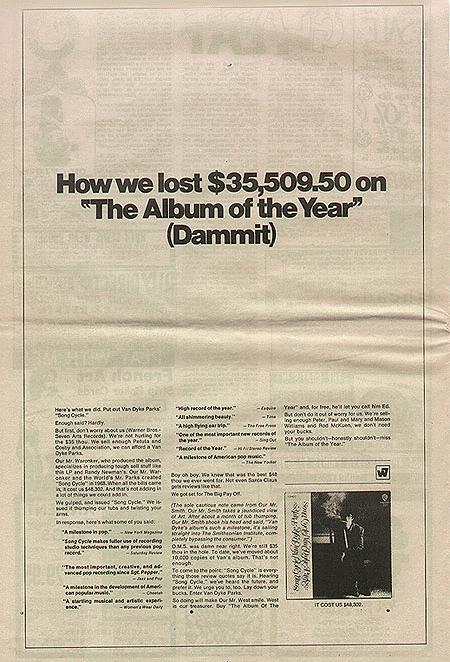
Book Review: 33 1/3 #74 Song Cycle


It would be an understatement to say this is merely sad. Even the Wikipedia page for the album provides very little information or insight into an album that, by all means, is one of the best of the 60's. This isn't surprising, of course, as Song Cycle was barely purchased upon its release, and its praises rarely sung by any but the most well-informed critics in the decades following the album's entrance into the world of popular music. As such, the task of anyone choosing to write about an album like Song Cycle might be a bit daunting. In his entry into the 33 1/3 series about Parks' album, Richard Henderson largely rises to the occasion with a volume that is very purposeful and thorough, if a bit dry at times. Of course, saying the book is dry "at times" might also be a bit of an understatement. In all honesty, Henderson's volume, while well written on a technical level, is a bit of a slog because the author is so dedicated to the album's (and Parks') history that it's easy for a reader to get swallowed up in the dense torrents of information. Henderson occasionally tries to get playful--especially in the book's first section, which happens to be a highlight--but ultimately, while full of outstanding information, the volume is a bit of a drag to read.

But that's okay for this book. In past reviews of 33 1/3 books I've been quite critical of overly-traditional approaches to the featured albums. Song-by-song summaries and analyses, chapters that compartmentalize the various facets of an album's production and reception, loads of facts without any fresh ideas--these are all elements of 33 1/3 books I've taken issue with in the past, and all of them are present in Henderson's Song Cycle. But while a plethora of books have been written about, say, AC/DC and plenty of articles written about and interviews conducted with My Bloody Valentine, Henderson's work on Parks is filling a glaring void. We see this even more when we look at the bibliography at the back of Henderson's volume and see it filled with books about Brian Wilson, 60's pop music, California pop music, recording studio histories, record label histories--but nothing about Van Dyke Parks. So yes, Henderson's Song Cycle is dry and even a bit banal, but the author had little choice. Many authors of 33 1/3 books have had the benefit of a rich and varied body of writing about their chosen albums from which to draw, which ultimately frees them to approach said albums from interesting and unique angles. Henderson did not have this luxury.

And of course, there are some fascinating and engaging moments throughout the book. In particular, the opening chapter, in which Henderson describes how he came to the album, is fun and engaging, and the section dealing with the controversial marketing of Song Cycle is a wonderful case study of the 60's music industry and the tensions that arose between "big business" and "counter-culture" art.

But by and and large, Henderson's Song Cycle is more the type of book that fans and scholars of pop music should read rather than one they'll necessarily want to read. And that's fine--because they should read the book. They just shouldn't expect to have their socks knocked off with the exciting prose and new insights that the 33 1/3 series has been so good at providing as of late.

=======

Next Up: I don't know--my stack of unread 33 1/3's has grown immensely. I might pick one at random.

Wednesday, April 20, 2011

Songs that Changed the Landscape of Human Thought and Understanding: USA for Africa's "We Are the World"

There has never been a song in the annals of history that has fused egoless philanthropy with pure pop-songwriting chops the way USA for Africa's mega-hit "We Are the World" did in 1985. This supergroup, this X-Men of musical acts, reminded us who "we" are, that WE are "the world," and that it is indeed a heavy burden, literally. According to Wikipedia, the Earth weighs over seven gajillion tons. And that's heavier than two stoned hippies* having a conversation about how "we are the world." So how are we the world exactly? That is the question Michael Jackson and Lionel Richie, the song's composers, set out to ask. And, fortunately for us listeners, they answer the question with ease. They also make us feel good for solving what had previously seemed to be a problem without a remedy: WORLD HUNGER. Through sheer hope, starpower, and the insane amount of cash money generated by the song, the people of Ethiopia were able to forget about an unforgiving climate--which provided the region with a historically devastating drought and subsequent famine--and the long history of European colonization of the African nations surrounding them. I bet you never did anything that cool. Seriously. I know I haven't. Feeling special because I once helped out my grandmother during her walk for Breast Cancer Awareness just makes me feel like a great big jerk in comparison. Perhaps the song's greatest achievement, though, is that it presents a universal, timeless picture of who "we" are.

Who are we, then? Well, we are a bunch of popular musicians from the mid-1980s, that's who! We are Michael Jackson, Lionel Richie, Bruce Springsteen, Stevie Wonder, Willie Nelson, Hall and Oates, The Pointer Sisters, Kim Carnes, Cyndi Lauper, Huey Lewis and the News, Steve Perry, Sheila E., and James Ingram. We are pop-rock legends Bob Dylan, Ray Charles, Billy Joel, Harry Belafonte, Smokey Robinson, Dionne Warwick, Paul Simon, Kenny Rogers, the living half of The Blues Brothers, and Lindsay Buckingham. I think we can all relate to that. As an added bonus, the presence of the British musician Bob Geldof (the brainchild of Band Aid) on the track lets every listener know that one of the goals of "We Are the World" was to make the world forget about "Don't They Know It's Christmas," the most religiously presumptuous song ever recorded (well, except for Carrie Underwood's "Jesus, Take the Wheel").

The song also speaks generally to the human condition. There are most certainly always times "When we heed a certain call / When the world must come together as one." Since we are the world, we are also "the children" as well as "the ones who make a brigher day." Because, ultimately, this is an existentialist "choice we're making," as we are a part of "God's great big family," there is only one choice: to "[save] our own lives." Cool beans. Most people can't handle the responsibility of their own job, let alone feeding and clothing the entire populace and knowing that their actions are, essentially, the actions of all seven billion people on this planet. Therefore, "We Are the World" is the most reassuring song ever recorded. Whenever we slip up--like, say, we forget to pick up our kid from school because we were deep into a game of World of Warcraft--we can realize that we are just a microcosm of this world that we also are, that for every mistake, we are actually our own lives, and we are curbing world hunger while we're at it. And for those critics who think this message is convoluted, well it's not. You are. Get me? Or, rather, get we? Are the world?

The knowledge that we are all helping goes down so much more smoothly with great vocal performances. And "We Are the World" has 'em by the boatload. The song is highlighted by that most dulcet of crooners, Bob Dylan. When he sings, "There's a choice we're may-can / We're saving aaaahhhh own liiiiives / It's trooooo we make a bedduh day / Just yooooooo and meeeee," you can literally feel that same burning passion in in the pit of your stomach. Similarly, Bruce Springsteen feels so committed to this message that apparently he didn't have a bowel movement for two weeks before he recorded his take. It meant that much to him. And with that kind of focus and determination, USA for Africa's "We Are the World" was and will always be a song that changed the landscape of human thought and understanding.

*-I'm fully aware that the phrase "stoned hippies" is redundant.

Below is the rousing video for the song. Try not to shed a tear for our greatness: