Thursday, June 2, 2011

Songs that Changed the Landscape of Human Thought and Understanding: Spandau Ballet's "True"

It was 1983. People drove to work in horseless carriages. They used telephones with wires attached to them. They wondered how Ronald Reagan's hair got so darned black. It was also the year that we learned the truth about truth. Spandau Ballet's tasty piece of "sophisto-pop," "True," is easily one of the most mind-blowingly brilliant singles ever committed to any recorded media. Gary Kemp, the song's writer, penned the perfect melody for the group's baritone singer, Tony Hadley, who articulately communicates, to his audience, the essence of truth. In the process, he makes a mockery of Western philosophy with brilliant ease.

Philosophers had been contemplating truth for years, from the Platonic ideal to the Nietzschean will to power. A breakthrough occurred in the 1930s, when philosopher Alfred Tarski gave the following example: "Snow is white if and only if snow is white." You can't argue with that logic. Well, Spandau Ballet decided to revise this precise if nonsensically coined formula by way of a fruitful combination of British New Wave and Yacht Rock. Tony Hadley seemingly non-verbal singing during the chorus actually packs plenty of meaning. "Ah ah ah ahhhh ah," he sings, in sexy croon-breaths. What most listeners fail to realize upon first listen is that this utterance is the crystallization of all truths. He explains, "Why do I find it hard to write the next line? / Oh I want the truth to be said," continuing, "Ah ah ah ahhhh ah / I know this much is true." What could quite plausibly be understood as an admission of writer's block is really a profound, mind-blowing truth in and of itself: "Ah ah ah ahhhh ah" is truth and truth is "Ah ah ah ahhhh ah." Suck on that, Alfred Tarski.

The key to understanding the perspective of Spandau Ballet is hidden within its chorus as well. Hadley sings, "I bought a ticket to the wor-or-orld, but now I've come back again." Clearly, Spandau Ballet was collectively abducted by a super-intelligent race of skinny tie-wearing aliens who taught them their culture and all of their knowledge. The only thing they couldn't teach Spandau Ballet was how to alleviate homesickness and how to give up the desire to feel sexy. So, after some time spent in space, probably in the months between their 1982 album Diamond and the one this appears on (clearly also titled True), they purchased tickets to return to Earth. Fueled by this new knowledge, as well as months of pent-up sexual frustration, they were inspired to tell us "this much is true" as well as include one of the decade's hottest slow-burn sax solos during the bridge.

It cannot be denied, ever, that "True" has fundamentally changed both the perceptive and linguistic truths of humankind. In the years since, we've had Madonna's "True Blue," P.M. Dawn's "Set Adrift of Memory Bliss," as well as The Truth About Cats and Dogs. Probably the most telling way it has affected culture, at least in the United States, is that when a witness has to take an oath in the courtroom, they now just sing, "Ah ah ah ahhhh ah."

Monday, April 25, 2011

Book Review: 33 1/3 #74 Song Cycle


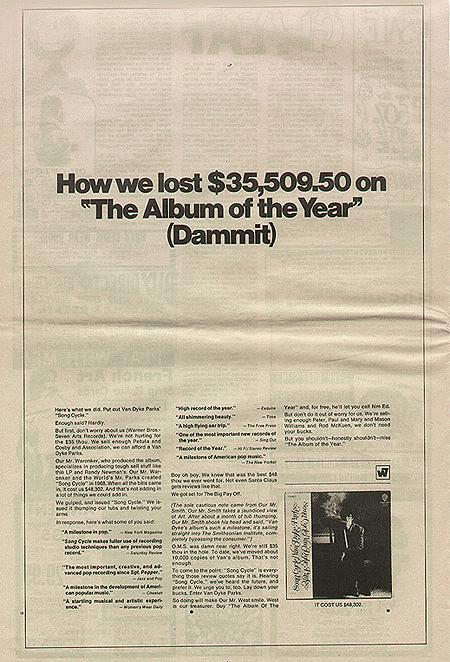
It would be an understatement to say this is merely sad. Even the Wikipedia page for the album provides very little information or insight into an album that, by all means, is one of the best of the 60's. This isn't surprising, of course, as Song Cycle was barely purchased upon its release, and its praises rarely sung by any but the most well-informed critics in the decades following the album's entrance into the world of popular music. As such, the task of anyone choosing to write about an album like Song Cycle might be a bit daunting. In his entry into the 33 1/3 series about Parks' album, Richard Henderson largely rises to the occasion with a volume that is very purposeful and thorough, if a bit dry at times. Of course, saying the book is dry "at times" might also be a bit of an understatement. In all honesty, Henderson's volume, while well written on a technical level, is a bit of a slog because the author is so dedicated to the album's (and Parks') history that it's easy for a reader to get swallowed up in the dense torrents of information. Henderson occasionally tries to get playful--especially in the book's first section, which happens to be a highlight--but ultimately, while full of outstanding information, the volume is a bit of a drag to read.

But that's okay for this book. In past reviews of 33 1/3 books I've been quite critical of overly-traditional approaches to the featured albums. Song-by-song summaries and analyses, chapters that compartmentalize the various facets of an album's production and reception, loads of facts without any fresh ideas--these are all elements of 33 1/3 books I've taken issue with in the past, and all of them are present in Henderson's Song Cycle. But while a plethora of books have been written about, say, AC/DC and plenty of articles written about and interviews conducted with My Bloody Valentine, Henderson's work on Parks is filling a glaring void. We see this even more when we look at the bibliography at the back of Henderson's volume and see it filled with books about Brian Wilson, 60's pop music, California pop music, recording studio histories, record label histories--but nothing about Van Dyke Parks. So yes, Henderson's Song Cycle is dry and even a bit banal, but the author had little choice. Many authors of 33 1/3 books have had the benefit of a rich and varied body of writing about their chosen albums from which to draw, which ultimately frees them to approach said albums from interesting and unique angles. Henderson did not have this luxury.

And of course, there are some fascinating and engaging moments throughout the book. In particular, the opening chapter, in which Henderson describes how he came to the album, is fun and engaging, and the section dealing with the controversial marketing of Song Cycle is a wonderful case study of the 60's music industry and the tensions that arose between "big business" and "counter-culture" art.

But by and and large, Henderson's Song Cycle is more the type of book that fans and scholars of pop music should read rather than one they'll necessarily want to read. And that's fine--because they should read the book. They just shouldn't expect to have their socks knocked off with the exciting prose and new insights that the 33 1/3 series has been so good at providing as of late.

=======

Next Up: I don't know--my stack of unread 33 1/3's has grown immensely. I might pick one at random.

Wednesday, April 20, 2011

Songs that Changed the Landscape of Human Thought and Understanding: USA for Africa's "We Are the World"

There has never been a song in the annals of history that has fused egoless philanthropy with pure pop-songwriting chops the way USA for Africa's mega-hit "We Are the World" did in 1985. This supergroup, this X-Men of musical acts, reminded us who "we" are, that WE are "the world," and that it is indeed a heavy burden, literally. According to Wikipedia, the Earth weighs over seven gajillion tons. And that's heavier than two stoned hippies* having a conversation about how "we are the world." So how are we the world exactly? That is the question Michael Jackson and Lionel Richie, the song's composers, set out to ask. And, fortunately for us listeners, they answer the question with ease. They also make us feel good for solving what had previously seemed to be a problem without a remedy: WORLD HUNGER. Through sheer hope, starpower, and the insane amount of cash money generated by the song, the people of Ethiopia were able to forget about an unforgiving climate--which provided the region with a historically devastating drought and subsequent famine--and the long history of European colonization of the African nations surrounding them. I bet you never did anything that cool. Seriously. I know I haven't. Feeling special because I once helped out my grandmother during her walk for Breast Cancer Awareness just makes me feel like a great big jerk in comparison. Perhaps the song's greatest achievement, though, is that it presents a universal, timeless picture of who "we" are.

Who are we, then? Well, we are a bunch of popular musicians from the mid-1980s, that's who! We are Michael Jackson, Lionel Richie, Bruce Springsteen, Stevie Wonder, Willie Nelson, Hall and Oates, The Pointer Sisters, Kim Carnes, Cyndi Lauper, Huey Lewis and the News, Steve Perry, Sheila E., and James Ingram. We are pop-rock legends Bob Dylan, Ray Charles, Billy Joel, Harry Belafonte, Smokey Robinson, Dionne Warwick, Paul Simon, Kenny Rogers, the living half of The Blues Brothers, and Lindsay Buckingham. I think we can all relate to that. As an added bonus, the presence of the British musician Bob Geldof (the brainchild of Band Aid) on the track lets every listener know that one of the goals of "We Are the World" was to make the world forget about "Don't They Know It's Christmas," the most religiously presumptuous song ever recorded (well, except for Carrie Underwood's "Jesus, Take the Wheel").

The song also speaks generally to the human condition. There are most certainly always times "When we heed a certain call / When the world must come together as one." Since we are the world, we are also "the children" as well as "the ones who make a brigher day." Because, ultimately, this is an existentialist "choice we're making," as we are a part of "God's great big family," there is only one choice: to "[save] our own lives." Cool beans. Most people can't handle the responsibility of their own job, let alone feeding and clothing the entire populace and knowing that their actions are, essentially, the actions of all seven billion people on this planet. Therefore, "We Are the World" is the most reassuring song ever recorded. Whenever we slip up--like, say, we forget to pick up our kid from school because we were deep into a game of World of Warcraft--we can realize that we are just a microcosm of this world that we also are, that for every mistake, we are actually our own lives, and we are curbing world hunger while we're at it. And for those critics who think this message is convoluted, well it's not. You are. Get me? Or, rather, get we? Are the world?

The knowledge that we are all helping goes down so much more smoothly with great vocal performances. And "We Are the World" has 'em by the boatload. The song is highlighted by that most dulcet of crooners, Bob Dylan. When he sings, "There's a choice we're may-can / We're saving aaaahhhh own liiiiives / It's trooooo we make a bedduh day / Just yooooooo and meeeee," you can literally feel that same burning passion in in the pit of your stomach. Similarly, Bruce Springsteen feels so committed to this message that apparently he didn't have a bowel movement for two weeks before he recorded his take. It meant that much to him. And with that kind of focus and determination, USA for Africa's "We Are the World" was and will always be a song that changed the landscape of human thought and understanding.

*-I'm fully aware that the phrase "stoned hippies" is redundant.

Below is the rousing video for the song. Try not to shed a tear for our greatness:

Tuesday, March 29, 2011

Songs that Changed the Landscape of Human Thought and Understanding: Baha Men's "Who Let the Dogs Out?"

Last Friday, my office-mate Jill told me she had to go home in order "to let the dogs out." Ergo, in true Jeopardy fashion, "Jill" is the answer to the notoriously prickly question asked in 2000 by the Baha Men in their riddle-for-the-ages anthem "Who Let the Dogs Out?"

Thursday, March 24, 2011

Songs that Changed the Landscape of Human Thought and Understanding: Rebecca Black's "Friday"

People make a really big deal about certain days of the week. Nobody likes Mondays. Out of the seven days in a week, most die on a Tuesday. Wednesday is rather perversely known as "hump day." Thursday ... well, I honestly can't tell you what the hell is Thursday good for. But we all know the one day of the week that undoes the previous four days and gets us ready for the next two: Friday. Thankfully, thirteen year-old Rebecca Black reminds us how much this day of the week totally dominates in her 2011 smash hit aptly titled "Friday."

Friday hasn't always been the most popular day of the week. In fact, it is common knowledge that Saturday was THE DAY throughout most of human history. This changed, however, in the 17th Century, after the first performances of William Shakespeare's comedy As You Like It, when it appears that Fridays and Saturdays became tied as the favorite days of the week. In it, Orlando commands Rosalind to "love" him. Rosalind replies, "Yes, faith, will I, Fridays and Saturdays, and all." From this point until the release of the double-whammy of the 1975 television comedy show Saturday Night Live and the 1977 film Saturday Night Fever, it appeared that people still preferred Saturdays. However, the following year saw the release of another disco classic, Thank God It's Friday, and the tables forever turned. From this point on, Fridays were King. The film itself is solely responsible for this exultation. Subsequent studies have in fact proven that Friday itself is absolute proof of a Judeo-Christian God, hence the very phrase "Thank God it's Friday," and, of course, that glorious chain of fine dining establishments, whose food has more product in it that Guy Fieri's hair. Plus, would the formerly most pissed-off rapper in the world Ice Cube have made THREE films about the day if it wasn't so inherently excellent? I think not. When he says, "Damn it was a good day," it's of course Friday he is talking about, not lame ass Tuesday. Seriously. Besides, who would ever eat at a place called Thank the Absence of a Deity It's Friday? TTAOADI Fridays just doesn't roll off the tongue well at all.

Like blue moons, or people who have watched Showgirls all the way through sober, Friday's are rare. They only happen once every seven days. As a result, we need to be constantly reminded about them and their genius. Fortunately, Rebecca Black reminds us, and how. Nestled over a Euro-dance groove, Black's mixolydian dulcet drone of a voice presents Fridays for what they really represent: possibility. According to Black, Friday's present all kinds of crazy options. Should one be "kickin' in the front seat," or perhaps decide on "sittin' in the back seat"? "Everybody's looking forward to the weekend," she sharply observes. She points out how strong desire really is, in ways no other human has so directly expressed. While people have "fun, fun, fun" and like to go "partyin' partyin'" on the weekends, looking forward to all this fun and all this partying is far more cathartic. The weekends become, to evoke the theorist Roland Barthes, a pleasureable text, a jouissance, as our desire for revelation is intrinsically more pleasurable than the revelation itself. Also, because Friday's are so rare, we often forget "yesterday was Thursday" and that "tomorrow is Saturday" and "Sunday comes afterwards." It's that intense of an experience, this Friday thing.

In short, we should all not only Thank God It's Friday, or Tell God to Shove It Because It's Not, but we should Thank Rebecca Black for Reminding Us How Awesome Fridays Are. Even if that creepy rapper guy who makes a cameo toward the end of the song seems way too thrilled about passing a school bus.

Here's the brilliant promotional clip for the song:

Tuesday, March 22, 2011

Book Review: 33 1/3 #77 Tusk


Rob Trucks opens his volume on Fleetwood Mac's classic album "Tusk" with a warning of sorts: "There's a character named Rob in this book who functions in ways that may or may not clearly relate to Fleetwood Mac's Tusk, and if you don't feel like you can handle that, then by all means put this book down." Trucks' "warning" does two things for me--first, it really kind of annoys me. Okay, so you wrote a not entirely conventional piece of music journalism. So what? So some boring readers don't like it when music journalism has things like "personality" and "style" and only want to read the same boring facts and anecdotes presented in the same boring way over and over again. By "warning" these people away from a book, you're essentially apologizing to them for not writing the book they would have written. Never apologize to those people. Odds are, what you've written is better than what they would have written. Odds are, what you've written is better than they're ideal of what should have been written. Second--the warning made me more excited about the volume than I had been. Tusk has always been my favorite Fleetwood Mac album, but then, I've never been a huge Fleetwood Mac fan, so that doesn't mean much. Trucks' "warning" sent a clear message to me that said, "hey, this book could be a little bit bold--I like bold, let's read."

And read I did.

And to be honest, Rob Trucks has some serious chops. He does a nice job of navigating dueling stories about the creation of Tusk with moments from his own life which, at times, hardly seem relevant to the album, but which ultimately add up to some sort of psychic and/or spiritual homage to the album's creation and themes. What makes this even more impressive is that Trucks never condescends to his audience, never feels the need to explicitly explain the connection between the bits of memoir and the bits of Fleetwood Mac history. He lets us intuit the relationship. Let's us feel our ways in, around, and through his experiences and how they play off of Tusk. The end result is not just a book that is engaging and smart with a clear emotional core, but a beautifully written, ecstatically felt study of subjectivity and art that might even deserve a second read.

Of course, not everything is perfect in Trucks' take on Tusk. A few of the "What We Talk About When We Talk About Tusk" sections--in which Trucks interviews musicians about the album's influence on their careers--feel a bit tacked on and completely unnecessary and/or uninteresting. Avey Tare's insight into Tusk is about as interesting and relevant as his latest solo album (burn!) and the Walter Egan section, though only a few pages, is pretty boring.

All in all, though, Rob Trucks has delivered a fine volume in a run of great volumes for the 33 1/3 series. His prose is crisp and fresh and I enjoyed learning about Rob Trucks' relationship to Tusk as much as I enjoyed learning about the album itself.


=======

Next up, Van Dyke Parks' Song Cycle.

Friday, March 18, 2011

"We're Not Above Reviewing Leaks": Vivian Girls - Share the Joy

Ever since the Vivian Girls got their big break (relatively speaking) in 2008, they have been extremely busy. They have gone through two drummers, Frankie Rose (now with the Dum Dum Girls) and Ali Koehler (who subsequently joined Best Coast). They cut their vastly underrated second LP Everything Goes Wrong. They have also formed a record label (Wild World Records) and engaged in numerous side-projects. Cassie Ramone has recorded and toured as The Babies along with Woods bassist Kevin Morby. Kickball Katy Goodman has been especially active, releasing an EP and a 7" (including last year's most delicious shoegaze moment in "It'll Come Around") with Gregg Foreman as All Saints Day as well as a full-length, eponymous LP as La Sera, featuring two of the coolest videos made in the last eight months (check out the grim yet free-spirited clips for "Never Come Around" and "Devils Heart Grows Cold"). Oh, and it should also be noted that they have toured constantly in the meantime. So how did the Girls find the time to write songs and record their latest album Share the Joy? And is it any good?

Share the Joy is the Vivian Girls' third studio LP, their first for Polyvinyl Records. On it, they retain their jangly approach to pop and hardcore punk which is, as always, loaded with tasty girl-group harmonies. There are a few noteworthy developments here, though. Cassie Ramone's songwriting skills continue to improve. The group's harmonies are as lush as ever. Lastly, Cassie Ramone's guitar leads are more assured, more adventurous, often confidently straying away basic melody. It also boasts the best fidelity of their three albums thus far. While for most listeners this would appear to be a good thing, Share the Joy does lack the zestful naivete of their generally over-hyped debut (Vivian Girls) as well as the crisp immediacy and fury of Everything Goes Wrong. Lastly, new drummer Fiona Campbell lacks the precision of the recently departed Ali Koehler, but is still a vast improvement over Frankie Rose.

The album opens with the stunning "The Other Girls," the Girls' longest track to date (clocking in at six-and-a-half minutes). Cassie Ramone's simulated twelve-string jangle, along with Kickball Katy's insistent, thumping James Jamerson-inspired bassline, carry the listener on a journey that includes Ramone's most impressive guitar solo thus far. The album's first single, "Heard You Say," finds them in minor-chord pop terrain, highlighted by their hallmark vocal harmonies, especially during the chorus, and a guitar solo that sounds like it was played on a twelve-stringer. Songs like"Lake House" and "Trying to Pretend" retain the angst of the previous album with cleaner production. Share the Joy's most overt nod to 1960s girl groups comes by way of "Take It as It Comes," which has a spoken-word dialogue between Cassie Ramone and Kickball Katy that recalls the opening of The Shangri-Las' 1965 masterpiece "Leader of the Pack," albeit far more lighthearted, as its focus is on "boy problems" rather than, say, a fatal motorcycle crash. As a result, it is the most fun cut on the album. They don't stray away from the topic of mortality, though. They re-record "Death," which previously appeared on their limited edition 2009 7" for the song "Moped Girls." The album closes with another six minute track in "Light in Your Eyes," which essentially re-delivers the single "Heard You Say" with far more seriousness and scope. Share the Joy benefits from having the most variety of a Vivian Girls album to date. There is plenty to like here for fans and neophytes alike. While it lacks the sizzle of their previous album, Share the Joy reveals a group that is continually growing and redefining their aesthetic.

--Share the Joy will be released on CD and vinyl courtesy of Polyvinyl Records on April 12. It is currently available for MP3 downloading at Polyvinyl Records' website.