Monday, August 30, 2010

Songs that Changed the Landscape of Human Thought and Understanding: Paris Hilton's "Stars Are Blind"

When people say something hyperbolic like "That song saved my life," they mean that that particular song--whatever it may be--inspired them to change the direction of their life. Maybe it gave them the idea to quit doing drugs, to switch occupations, to be a better spouse, or to join the United States Peace Corps. NOBODY who says something like this, though, has ever had their life literally saved by a song. I know that I generally refrain from disclosing many details from my personal life when I write about the songs that changed the landscape of human thought and understanding. But perhaps you, the ever-so-gracious reader, would be willing to allow this one indulgence? I only ask because a song HAS saved my life. I was only a few seconds from dying when divine intervention intervened, giving me another chance at living this life. For I was resurrected like Lazarus by the dulcet tones of Paris Hilton's 2006 smash hit "Stars Are Blind."

The Spring of 2006 was a bad time for your humble narrator. I was fired from a prestigious, well-paying job, on a late Friday afternoon, because I was "not mean enough." Losing the job didn't hurt my feelings so much as the reason why I got canned. To make matters worse, I received a call from my ex-boss the following Wednesday. She told me that they would have re-hired me if I would have protested my firing and "showed a little chutzpah." Apparently, the cliche "Nice guys finish last" is actually true. To make matters worse, my mother saw a picture of me that I had recently posted on MySpace and said that I "looked way too skinny." My mother, usually a very nice woman, had never, and I sincerely mean this, never insulted me once in my entire life. And she knew I was insecure about being too thin. As a result, I gave up my life-long vegetarianism and began eating MickDonald's and Olive Oyyul's Chicken twice a day (that's right, both of them). I started gaining weight. My mother never even mentioned the weight thing again. Well, around this time, my mother was becoming as moody and erratic as I was. To make matters worse, out of nowhere, my girlfriend at the time left me. She left a note on the front door that read, "I'm leaving." That was it. All her stuff was gone, and, for some reason, she took all of my fishing gear (and nothing else of mine?!). Two weeks pass, and I've eaten nothing but fast food and, curiously enough, haven't heard a word from my mother, who used to call me every day. Then, out of nowhere, she calls, telling me she's on vacation at Niagara Falls. She tells me she has a surprise. She puts my ex-girlfriend on the phone who proceeds to tell me that she's in love with my mother and that they plan on moving to Massachusetts to get married. My pride and masculinity crushed, not to mention being totally weirded out by the Freudian smorgasbord of jacked up family issues at work with this whole scenario, I went to a Patrick Swayze Roadhouse near me and vowed to eat one of their 64 ounce steaks in a hour. Within twelve minutes, I was clearly full and had more than 3/4 of the steak to eat. I decided to jam one rather healthy hunk of the New York Strip down my gullet. I quickly realized this was a bad idea right as I started to choke. I tried to signal to the wait staff that I was choking, but they were all doing a line-dance to Big and Rich's "Save a Horse (Ride a Cowboy)." As I almost slipped away, the song stopped and the PA system in the restaurant went right to the chorus of Paris Hilton's "Stars Are Blind," when she sings, "Even though the gods are crazy / Even though the stars are blind / If you show me real love baby / I'll show you mine," and, I kid you not, the song wrapped its arms around my diaphragm and thrust its fists, immediately ejecting the piece of grisly meat from my windpipe. I was saved, thanks to Paris Hilton and her amazing song. She is right on the money when she sings, "It could get physical," and, later, "This moment is critical." Without the physical application of the Heimlich Maneuver at that "critical" moment, I would probably be dead.

Because of that near-death experience, I now see that song in a totally different light. What she's saying is that we are filled with dualities, competing drives, and though we usually choose one over the other, these choices are never so easy, like when she sings, "I can make you nice and naughty / be the devil and angel too / got a heart and soul and body / let's see what this love can do." Before, I just thought the song's lyrics were told from the perspective of a person who was only using poorly-phrased rhetorical pleas to beg for sex. But now, I realize it is so much more than that, its tropical musical backdrop merely providing a mental vacation from the unconscious hard work of our conflicted minds. Even if, as the dead Lester Bangs points out, "There has never been a song that has sounded so much like Blondie's 'The Tide is High' since Blondie's 'The Tide is High,'" that doesn't dispel the true fact that "Stars are Blind" saved my life. Maybe it will one day save yours.

Thursday, August 19, 2010

Songs that Changed the Landscape of Human Thought and Understanding: Meat Loaf's "I Would Do Anything for Love (But I Won't Do That)"

Love makes the world go 'round, literally. Every time a person utters the word, draws a heart, or puts "XOXOXO" at the end of a text message, it powers the rotation of our planet. It's science. It's true. It's been that way forever! Because of this, people have done some strange things for love. Wars have been fought for "love of country." People will occasionally murder somebody in "a fit of passion." But, thanks to Meat Loaf and his Wagnerian #1 hit "I'd Do Anything for Love (But I Won't Do That)," we now know that there exists THE POSSIBILITY of things that people would not ever be willing to do for love. Here is just a brief list of some of the things Meat Loaf wouldn't do if we totally run on the assumption that his love-interest has some rather EXORBITANT demands:

--He wouldn't stick his left leg in a wood-chipper.
--He wouldn't get a large tattoo of a swastika on his forehead and walk around Jerusalem.
--He wouldn't eat human flesh marinated in Box-of-Wine puke.
--He wouldn't call his significant other 'Mommy Dearest' during sex.
--He wouldn't get a job as a telemarketer.

For nearly two decades now, people have wondered what Meat Loaf WOULDN'T do for love as they ponder the miracle of this song. During the chorus, when Meat Loaf initially admits, "I would do anything for love," we as listeners assume this is unconditional. However, mindblowingly, he immediately disqualifies the claim, adding, "But I won't do that." This is all just a part of the web that makes "I'd Do Anything for Love (But I Won't Do That)" so genius. The listener is forever left to speculate what "that" really is. Perhaps the most radical achievement of the track, though, is that it undid years of damage caused by the powerful jingle "What would you do for a Klondike Bar?" I'm pretty sure that if somebody did a mash-up of the two songs, a black hole would immediately form.

Marvin Lee Aday, nee Meat Loaf, rose to superstardom in 1977 with the release of his album Bat out of Hell. With its campy lyrics, over-the-top production, and Meat Loaf's dramatic vocals, it went on to sell over 14 million copies in the U.S. Success, though, eluded the Loaf in the years following Bat out of Hell. And by the early 1990s, he was more known, to the kids at least, for his part in The Rocky Horror Picture Show (1975) than for "Paradise by the Dashboard Light." After patching things up with Bat out of Hell composer Jim Steinman, the two got back together at an unlikely time in music history. The year was 1993. Grunge had dethroned the likes of Michael Jackson and M.C. Hammer from the top of the charts. Bill Clinton was pissing off Republicans. The Clapper was in bedrooms all across the United States. What the world needed was a song that fused that old Meat Loafiness with one of the eight-minute songs from Guns N' Roses' Use Your Illusion II that made us, as human beings, rethink the power of love and its limitations.

The seven-minute song (the album version is twelve minutes long!) is passionately sung by the Loaf as he easily convinces the listener just how HARD he loves. I mean, shucks, he is willing to "run right into hell and back" for it. (Of course, this only seems extreme if one believes there is a hell. Literally running into "an abstract concept" and back suggests he is barely willing to do the minimum amount possible for love.) After making his case, he reaches the conclusion that there are some instances where indulging in outrageous actions for love are just not warranted. He just doesn't provide any specifics, though. The moral of the song is that people are prone to making bad decisions when they are in love (like the inability to recognize they have fallen in love with an utterly horrible person). Clearly, Meat Loaf's love-interest is using him because of his apparent gullibility, but he has been, up until now, unable to realize this dynamic. His love-interest (voiced by the otherwise obscure singer Mrs. Loud) gives Meat Loaf some rather esoteric exercises to prove his love to her near the end of the song, including "build[ing] an emerald city with these grains of sand," "colorizing" her "black and white" life, "tak[ing her] to places [she's] never known," and, weirdest of all, "hos[ing her] down with holy water." Meat Loaf is perfectly willing to do these things, which suggest that the guy is a total freak! However, after her un-named, specifically dubious demand, he now realizes how far he has gone and how much farther it will take for him to get back. I don't know what this means, but neither does anybody else.

The point is this: With "I'd Do Anything For Love (But I Won't Do That)," Meat Loaf created the most ambitiously ambiguous song in the history of animal-, plant- and man-kind. I still maintain, to this day, she has asked him to punt a football made of broken glass barefooted to prove his love to her. It's totally in the lyrics ... somewhere ... I guess. What do you think?

Sunday, August 15, 2010

"We're Not Above Reviewing Leaks": Robyn - Body Talk pt. 2

One of the biggest questions in twenty-first century pop music has to deal with North America's pop scene to greet Sweedish pop sensation Robyn with open arms. Not only does Robyn have some of the catchiest, best produced pop songs in recent memory, she also has the attitude and image of a star--almost. Perhaps North America's problem with Robyn--the thing keeping her from an acceptance of Aguillera/Pink/Timberlake/Gaga proportions--is that every facet of her pop star persona is just a half step off from the industry norm. She's got an unusual fashion sense, but not unusual enough. She's got a tough "bad girl" exterior, but also a warm, surprisingly human center that exposes the toughness for what it is, a facade. She brings killer club dance songs to the table, but peppers them with lines of playful bursts of midnight poetry. While these might be the reasons Robyn isn't massively successful State-side, they are also the reasons she is one of the most engaging and endearing pop starts making music at the moment.

On Body Talk pt. 2, the middle chapter to Robyn's alleged three mini-album Body Talk cycle, all of these idiosyncrasies are on full display, and work together to further illuminate just what makes Robyn so interesting. The album's songs veer from sincere pep talks like "In My Eyes," to the crude smack talk of "Criminal Intent," and "U Should Know Better," the later of which includes a surprising, and well employed guest vocal from Snoop Dogg. As usual, Robyn's ability to seamlessly blend the gooey bubble gum synths and heart-to-heart vocals of a song like "Hang With Me," with the electro-clash pulse and absurdly vulgar lyrics ("Even the Vatican knows not to fuck with me")of "U Should Know Better" is still the crux of the album's success, and points toward Robyn's biggest asset--her persona.

There are songs on Body Talk pt. 2, on both of the Body Talk albums for that matter, that shouldn't work. A song like pt. 2's "Include Me Out," with its overly earnest verses and nonsensical chorus should not work. But it does. And the reason it works is because of the balance Robyn maintains within her persona. She blends toughness with vulnerability, sincerity with knowing nods to pop artifice, and she does it all with an undeniable exuberance. Not many pop stars could get away with speaking the line "we dance to the beat of bad kissers clicking teeth," over a club-banging beat in a way that isn't embarrassing. Robyn does it, and the line is successful for the same reason Robyn is successful--it's fun and weird, a little bit awkward and a little bit sexy.

Like Body Talk pt. 1, this second entry is a solid collection of eight songs that sneak up on us, get under our skin, and don't leave us alone. Now with the first two installments of Body Talk to enjoy, let us wait with baited breath that pt. 3 arrives this year, as promised.

Wednesday, August 11, 2010

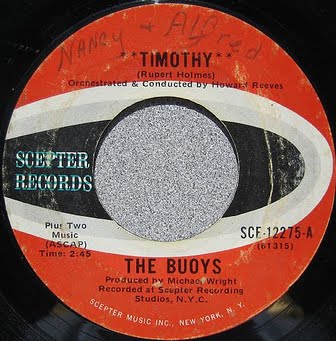
Songs that Changed the Landscape of Human Thought and Understanding: The Buoys' "Timothy"

Many things make us laugh. Like farts. Or platitudes. Or Crotch-shots on America's Funniest Home Videos. Or elaborate jokes involving three holes in a wall and a particularly vicious milking machine. These things are funny. And so is making fun of old people. One thing that's not funny, however, is cannibalism. Aside from incest or bestiality, humanity finds nothing more repulsive or terrifying than cannibalism. In fact, imperial powers often claimed the people they were colonizing were cannibals to justify their actions and to tame these so-called "barbarians" with bullets and poison-tipped arrows full of "civilization." Over the last sixty years, Americans have been morbidly fascinated with revolting mass murderers like Edward Gein and Jeffrey Dahmer, both of whom ate some of their victims. If there is one instance, though, when cannibalism seems to be only slightly less disgusting, it is in the act of survival. This is why the travails of the Donner Party in 1846-7 or the Uruguayan Air Force Flight 571 crash of 1972, dramatized more recently in the 1993 film Alive (directed by Frank Marshall), have long fascinated many people. I'm sure many people wonder just how deprived of food they would have to be to seriously consider cannibalism as a viable gastronomical option. More mind-blowing than any of these facts, well-researched though they may be, is The Buoys' 1970 hit single "Timothy." To date, it is the only American song about cannibalism to crack Billboard's Top Twenty.

The man who wrote "Timothy" was preoccupied with flavors. Rupert Holmes, The Buoys' pianist and "Timothy"'s scribe, would later become an international superstar with his epic single "Escape (The PiƱa Colada Song)," the yacht-rock song that would go on to define an entire generation."Timothy" presents the narrative of a small group of miners, three to be exact (the narrator, Joey, and Tim), who become trapped. The Buoys' lead singer, Billy Kelly, with his competent, impassioned voice deceptively relates this narrative, coming off as a Summer of Love crooner singing about flowers in his hair and getting crabs. The shuffling rhythm work of the group's guitarist, Chris Hanlon, is backed by a tight rhythm section, a light brass section, and some of the most deliciously sappy strings you'll ever hear. It is against this bubblegum wash of diabetic infectiousness that Billy Kelly delivers this chilling tale.

What is so brilliant about "Timothy" is that Kelly never mentions cannibalism by name. Instead, he drops hints. Seriously. The lines "Me and Joey feasted on the delicious meat of Timothy down in the mine / He sure was tasty! / We now have a constant craving for human flesh / Where's the A1 sauce? / Because we're totally cannibals now" do not appear in the song. Instead, Rupert Holmes' sly lyric begs the question, "Do you like Can-ni-bal-ism ... and getting caught in a mine?" The track's brutal setting is a mine disaster. Three men are trapped. But when they are rescued, only the narrator and Joey are to be found. During the chorus, the group sings, "Timothy, where did you go? God, I don't know." God refuses to answer their question because He hates cannibals. Clearly. He also dislikes people who sell their souls for just a piece of meat, like Joey, who tells our hungry narrator, "I'd sell my soul for just a piece of meat." The narrator, however, has no qualms about being a cannibal, because, unlike Joey, he makes no such Faustian deal to survive. He proves that, yes, there can be atheism in a foxhole, so to speak.

What elevates the song above being a cruel joke is its potent commentary on the dispiriting nature of collective apathy. In the final verse, the narrator mentions that he has blacked out, waking up to find himself rescued from the mine disaster. Curiously, his stomach is full. How on Earth did that happen? Clearly, the narrator is a lousy detective, as are his rescuers. The narrator notes, "Nobody ever got around to finding Timothy." Perhaps if they would have noticed the narrator's bib or how his breath curiously smelled just like Timothy, they would have found out the ugly truth. BUT NOOOOOO!

What The Buoys' "Timothy" actually accomplishes is quite stunning. In the song, they manage to rail against apathy, criticize the betrayal of ones own humanity, and make cannibalism seem cute and funny, WHICH IT IS NOT. Cannibalism is serious business, and no laughing matter. As a result of this song, the bubblegum pop scene of the early 1970s got just a little meatier, if you know what I mean?

Here's a clip of the song:

Friday, July 30, 2010

"Talking Reviews: James and Joshua Talk About...": The Suburbs, by Arcade Fire

Welcome to our newest series, Talking Reviews: James and Joshua Talk About.... This first review grew out of our complete inability to really wrap our heads around The Arcade Fire's enigmatic new album The Suburbs. Without further ado, here are James and Joshua talking about The Suburbs.


James: So, The Suburbs, the latest from The Arcade Fire, is something, isn't it? Thus far, I've found myself vacillating wildly on whether I like it or not. On the one hand, I like the more restrained approach, and less "we're here to change the world" attitude, but some of the production is lacking, the performances can be dull at times, and the album is a bit of a bloated mess. Also, the more I catch snippets of lyrics, I can't help but feel that Win Butler is being a bit too hard on the 'burbs. That being said, the album has me seriously thinking about seriousness and the importance of humor in pop music.

Joshua: That's a really interesting take. Can you elaborate on the lack of humor in this album?

James: More and more I find myself comparing the Arcade Fire to Bruce Springsteen due to the sense of urgency Butler tries to tap into with his delivery. What the Arcade Fire seem to be missing, however, is that such urgency and seriousness is only a part of Springsteen's persona. Even the Boss's darker albums, Darkness on the Edge of Town and Nebraska are shot through with moments of humor. The Arcade Fire don't do that and the results are growing increasingly dour and preachy--even with the new album's more personal songwriting approach (less war and God, more old friends and sad memories), the album's single-minded anger is eating the life from the songs.

Joshua: That makes sense. On The Suburbs, Arcade Fire certainly seem to take themselves seriously, and the concept of this particular concept album does seem to come across as rather single-minded at times. Ok, suburbs are boring, sprawl is bad. This isn't anything groundbreaking. And there are plenty of opportunities for humor here, but they do seem to let those moments pass.

I think this brings up an interesting shift I've noticed in indie music. One of the problems with alternative music of the 90s was that so many bands took themselves so seriously, likely as a reaction against the playfulness of 80s music. Eddie Vedder thought he could save the world, and Chris Cornell never once laughed at himself. But now we're seeing a lot of bands that seem to be perfectly comfortable having a laugh. Look at Sleigh Bells, who are my favorite new band of the year. Treats is an amazing album, and I think a lot of that has to do with the fact that they don't take themselves quite so seriously, even though they have that big, heavy sound. Ariel Pink is another good example, as is Surfer Blood. While these bands aren't going for the "ha ha" idea of humor, there is a playfulness that runs through those records. In this sense, Arcade Fire seem to have more in common with the alternative rock bands of the 90s. Has Arcade Fire missed the opportunity for humor entirely? Or do you think they would lose something if they were to take themselves less seriously?

James: That question is where this conversation can get messy. The problem I run into at this point is that for me to say, "no, the band wouldn't lose anything," would assume a sort of arbitrary necessity of playfulness or humor in music, and that isn't the case. Historically speaking, Radiohead, Joy Division, Pink Floyd, Jeff Buckley, to some extent The Cure--were/are all deathly serious, and have secure spots in music history. To a point, the Arcade Fire would lose a lot were they to take themselves less seriously because their legacy, thus far, is built on sincerity and seriousness. That being said, the seriousness is beginning to fail on experiential grounds. Part of living is failing, accepting our failures, accepting the failures of others and soldiering on. The Arcade Fire certainly are not strangers to soldiering on, but on an experience level, isn't one of our most profound ways of coping with failure to laugh about it? To laugh at ourselves and each other and know that what comes next will be better or, if not, we'll at least be better prepared to deal with it? In essence, by continuing to maintain the seriousness of the Arcade Fire throughout The Suburbs, the band is failing to recognize an essential component of lived experience. As a result, the band begins to appear as more of a construct of the sincere, bleeding heart artist as opposed to a living, breathing creative entity attempting to explore real human experiences. The question then, is how does Radiohead get away with their somber image? I'd argue that it is because Radiohead is a band about a central idea--alienation. The Arcade Fire's central idea hinges on sincerity, but they're limiting their sincerity by refusing to acknowledge anything but their serious concerns. The Arcade Fire are so intent on exposing the ills of the world and creating some sort of ideal notion of beauty in their music that they forget that joy is an absolutely crucial component of their paradigm. Of course, the album also falters a bit because some of the songs just aren't very good. This forces me to wonder, then, were The Suburbs as passionate as Funeral or parts of Neon Bible, could the heavy handed navel gazing have worked?

Joshua: I think that, because of the subject matter, had The Suburbs had as much passion as Funeral, it would have come off as absurd, at least in part. You can only get so passionate about your feelings on suburban life without sounding ridiculous. The very concept of suburbia is its restraint, its economy. So, in a large way, the form of this album does match its content.

Which brings me to one of my first thoughts about this album: In order to truly appreciate The Suburbs, I think we need to accept that this isn't an Arcade Fire album. That sounds ridiculous, because of course this is an Arcade Fire album. Their name is right there on the cover, no matter which of the eight variations on the cover you get. But this isn't the same band that put out Funeral. It's not even the same band that put out Neon Bible, and that was a very different Arcade Fire than the one we met on Funeral. The principle players were all there, but it's hard to listen to these albums and see it as the same band. They've evolved. Their sound has changed from one album to the next, much like Radiohead has done with each album, though perhaps to a lesser extent. Perhaps the better comparison would be someone like the Cure. Boys Don't Cry, Pornography, Japanese Whispers, Head on the Door, Disintegration, Wild Mood Swings, all of those albums sound different -- some so different you wonder what Robert Smith was thinking -- but there's still something that makes them easily identifiable as the Cure. Do you think Arcade Fire has a similar something that allows us to see each evolution as the same band? And in what ways do you think, through evolving, their sound has changed for good and bad?

James: The only real thread running through each of the Arcade Fire's albums is one we have discussed at length already--their attitude. Even as the subject matter shifts, the band is still utterly serious about every facet of their image, writing, and performance. Even a potential palette cleanser like "Month of May," from The Suburbs, comes off as a bit of a chore. I'd also slightly disagree with the assertion that were The Suburbs to sound like Funeral, that the album would be absurd. I'd argue that, in a lot of ways, Funeral was already about suburbia, but without any overt soap-boxing. That album was about growing up stifled by social constructs and loss, and the ways that young people fight to forge relationships and identities in the soulless suburbs. While some of those songs directly address neighborhood and the family structure, there is no sense that the suburbs are being judged, but are treated more as a launching point of ecstatic young lives. To that extent, Funeral is about the same spaces as The Suburbs and does a much better job covering that ground.

As for the evolution of the Arcade Fire's sound, I do like some of the melodic restraint running through parts of The Suburbs. I appreciate that not every major song on the album wants to be an anthem. "Suburban War," is a good example of this, and one of my favorite songs on the album. The song's lyrics tell a story about a character grown detached from the place where he used to live, and the people who populated that space. Lyrically, the song draws on some succinct, but specific detail (hair length, for example which, now that I think of it, recalls "Neighborhood #1 (Tunnels)") to tell this story. Musically, the song keeps itself in check--the performance is one of the album's more exciting, but it never explodes into a full on Arcade Fire anthem. Previous attempts at this approach (the song "Neon Bible," for instance) have come off a bit dull, but here the restrained emotion provides the song with a key tension that propels it to its big (but not anthemic) conclusion. Similarly, "City With No Children," while featuring a huge melodic hook (probably the album's strongest), also manages to exercise restraint and might be the tightest, most simple pop song of the band's career. The band's ability to make big songs like these without a larger-than-life sound or in-your-face, raise-your-lighters and wave-your-flags song structures is a nice change. That being said, some of the new album's lack of energy, and some of the songs' lack of development feel a bit under developed. In a way, this almost feels as if the band was overcompensating for their previous too-muchness. What are your thoughts on the band's evolution on The Suburbs?

Joshua: The first time I heard "The Suburbs," the first track on this album, I thought I had downloaded one of the fake versions that were floating around that day. The music sounded nothing like Arcade Fire. But when Win Butler's distinct voice came over, I realized it was just a very different product than I had expected. On that first listen, I wasn't much for this new sound, with its restraint and polish. With each subsequent listen, I've come to appreciate it more as an album. But still, I can't quite seem to grasp it or evaluate it. I can't tell how it fits in the band's canon. It seems like one of those albums that will take some time to develop for me.

One aspect that I do like about it is that Regine Chassagne seems to be playing a larger role in the band, or at least contributing more vocal leads to this album. In past albums, she seemed to occupy the George Harrison role, contributing one or two songs as variation, but mainly playing a backing role. But here, her songs seem an integral part of the album rather than variations from Butler's songs. And I think her vocals, more than any other aspect of the band's sound, benefit from the more slick production.

James: That's an excellent point on Regine's contribution this time out. While I don't always like the production on her songs (the Blondie-electro-pop sound of "Sprawl II" is a bit tired), I do feel like she brings a fresh energy to the album with each appearance.

All in all, I'm a bit perplexed by this album, but I think, ultimately, The Suburbs is going to end up being an okay album, with some great moments that are diluted by indifference and some outright bad decisions. Songs like "Rococo," "Sprawl (Flatland)," and "We Used to Wait," are a bit embarrassing in how broadly they fail, while others like "Empty Room," "Ready to Start," and "Deep Blue," are so innocuous that, even after a dozen listens through the album, I can never quite remember what they sound like. That being said, "The Suburbs," is nice, as are "Modern Man," "City With No Children," "Suburban War," and the two part "Half Light" suite. Ultimately, though, The Suburbs isn't nearly as major or important as The Arcade Fire wanted it to be, not only because the themes and ideas behind it don't work, but because not enough of the songs click--or rather, in this case, maybe because too many of them don't click. A part of me wonders how this album would sound with five fewer songs--if the bad and boring songs were cut, would this album better serve its themes? Would those big, brooding ideas be easier to swallow if there weren't so many boring moments littering the album's landscape like so many strip malls and SUV's?


Joshua: I agree with your assessment of many of these songs. I seldom ever skip tracks when listening to an album, but "Rococo" tempts me to hit "next" every time it comes up. And you nailed my favorite tracks -- "Modern Man," "City With No Children," "Suburban War," and both parts of "Half Light" are the songs that have resonated most so far.

Ultimately, I think this is a nice record. It's a good summertime album, and good driving music, even if it lacks that anthemic fist-pumping. But for an Arcade Fire album, I'm still left wanting something more. I don't think they'll ever recapture the brilliance that was Funeral; as long as I continue to hope they will, I'll continue to be disappointed and miss what's good about albums like this one. So it's best to take the album on its own merits. While its thematic material will likely turn some people off, the musical aspect of the songs and the production feel a lot safer and more direct than they have before, so I can see this being a more successful album than their past efforts. It certainly has the hype built up. I see this making a lot of year-end lists, especially from mainstream pubs trying to increase their street cred by choosing "hip" bands. But from where I stand right now, The Suburbs doesn't measure up with the best of what's been released this year. A good album, but not a great one.

Thursday, July 29, 2010

Songs that Changed the Landscape of Human Thought and Understanding: Kenny Rogers and Dolly Parton's "Islands in the Stream"

Solipsism is a word used by eighteen year-old teenage males to make themselves appear to be more intelligent than they really are. It is a concept wherein one believes that only the self exists, or that knowledge outside of one's self cannot be proved. As a result, when the term solipsist is used as an epithet for an individual, it is usually referring to what the Webster's* Revised New Post-International Dictionary describes as "a totally self-absorbed fucking asshole." Fortunately, for most of humanity, solipsism is not a philosophy with much popular traction, thanks in large part to the British poet John Donne, who reminds us, in "Meditation XVII," from his text Devotions upon Emergent Occasions (1624), that "No man is an iland, intire of it selfe." This without question proves that there is existence beyond the self. In fact, Donne elaborates, "Any mans death diminishes me, because I am involved in Mankinde; And therefore never send to know for whom the bell tolls; It tolls for thee." See? I told you so. However, despite Donne's convincing and well-phrased argument, there will always be naysayers. Two such doubters are Kenny Rogers and Dolly Parton, who communicate their point loudly and clearly on their legendary hit "Islands in the Stream," which was written by The Bee Gees.

Both Rogers and Parton had amassed a stellar backlog of hits by the time they decided to meet up in 1983. Rogers scored hits with "The Gambler" and "The Coward of the Country," while Parton had massive juggernauts with "Jolene," "I Will Always Love You," and "9 to 5." On this single, the lusty duo manage to brilliantly defy both the solipsists and John Donne's "no man is an island" notion of (human) being by asserting that THE BOTH OF THEM are islands, and that "everything is nothing" (actual lyric from the song) outside of them. Though Rogers and Parton had cut their teeth recording Country music, they jump head-first into the pop mainstream with "Islands in the Stream," thanks to Barry Gibb's knob-twiddlin'. Plunky keyboards and silky Stax-Volt horns bolster this exquisite tale of true love. In the process, the song redefines the art of lyricism as we will forever know it.

In the song, Kenny Rogers initially comes across as a stalker who feels "soft inside" after having looked hard "with a fine-tooth comb" for, presumably, a blond, busty, Southern belle. In Dolly Parton he finds this very woman, who manages to complete him. It soon blossoms into love ever-flowing. They confirm their unlikely union, singing, "We got somethin' goin' on." They quickly become sexually involved, as they "ride it together ... uh huh / makin' love with each other ... uh huh." Kinky! During the chorus, the illicit partners sing, "Islands in the stream / That is what we are / No one in between / How can we be wrong?" This chorus is INSANE. First off, an island cannot fit itself in a stream. It is PHYSICALLY IMPOSSIBLE. Second, they don't come across as selfish, but rather couplish. This is a word I've invented specifically to describe their mindset. And, besides, I have a Ph.D. in English, which gives me the license to just make up words. It's written in the fine print on the degree, in Latin. And here's another one: yuthresh--a verb meaning "to remove ones hands quickly from a blazing hot steering wheel on a sunny Summer day." And here's the word in a sentence: By pulling a yuthresh, the driver avoided suffering traumatic third-degree burns. But I digress. Nothing exists for Kenny Rogers or Dolly Parton outside of themselves, save for their steamy love. Their love is so large that, later in the chorus, they sing of traveling "to another world" that can hopefully contain it. Let us keep in mind that they sing this nearly thirty years before the release of James Cameron's 3D sci-fi epic Avatar (2009).

For better or worse, "Islands in the Stream" elevates solipsism to romance and contradicts John Donne by claiming that, indeed, man and woman can be islands, just so long as they are in streams. Do you ever notice new couples who are blissfully in love with each other, unaware of the world outside of their sensual glances? Of course you do. They're all over the place. And it's all because of Kenny Rogers and Dolly Parton's masterpiece that this happens.

*-The Webster here does not refer to Noah Webster**, the man whose dictionaries have made the world easier to define (drumroll please). It refers to an imaginary, gender-neutral, pan-ethnic lexicographer named Kelly Webster who I just made up out of thin air to avoid possible litigation.

**-These wonderful dictionaries would make a wonderful addition to your bookshelf.

Tuesday, July 27, 2010

Book Review: 33 1/3 #68 The Flaming Lips - Zaireeka

As I begin this review of Mark Richardson's 33 1/3 book on Zaireeka, I feel like I should be up front about a few circumstances and biases that make me particularly susceptible to coming off as a fanboy:


1. I really love The Flaming Lips, and have for quite some time.

2. My wife and I moved to Oklahoma about 2 years ago, heightening my previous enjoyment of The Flaming Lips and their music.

3. Mark Richardson has been my favorite Pitchfork writer ever since his essay discussing LCD Soundsystem's and John Cale's versions of "All My Friends." Since that time, he's one of only a couple of writers across the internet whose music writing I actively seek out.

With that out of the way, then, Richardson's contextual overview and analysis of The Flaming Lips' Zaireeka is one of the better entries in the 33 1/3 series. The reasons for the book's success are simple--Richardson sets out to teach readers about Zaireeka, and his information is shared with an easy prose style. In providing a survey of Zaireeka's creation and reception, Richardson begins with a brief history of The Flaming Lips, up to the point where they began experimenting with sound through the Parking Lot Experiments. Through this context, Richardson deftly weaves the band's personal histories with the development of The Flaming Lips as a musical entity and idea as they hit their stride over a decade into their career. At the same time, Richardson does a fantastic job of exploring the significance of Zaireeka as a musical text, and a work of art. In particular, Richardson's discussion the album's explicit challenge to the ever increasing importance of portability and convenience in music are particularly enlightening, and help position the album, not just in the context of the Lips's career, but in the history of recorded music.

The book loses a bit of momentum in its last quarter, as Richardson attempts to address the album from every uncovered angle in a brief span of time, but thankfully, through the use of personal narrative--a story of his own relationship with the music of The Flaming Lips, 90's culture, and Zaireeka--ends on a compelling note.

On a side note, I've noticed that the 33 1/3 books written on 90's albums tend to be feature some of the series' strongest writing. The books for Bee Thousand, 69 Love Songs, If You're Feeling Sinister, and Zaireeka are all outstanding. Part of me wonders if this is because the authors are writing more out of their own era and experiences, or if its simply a case of fresh ideas growing out of albums that haven't been over-talked by decades of rock criticism.